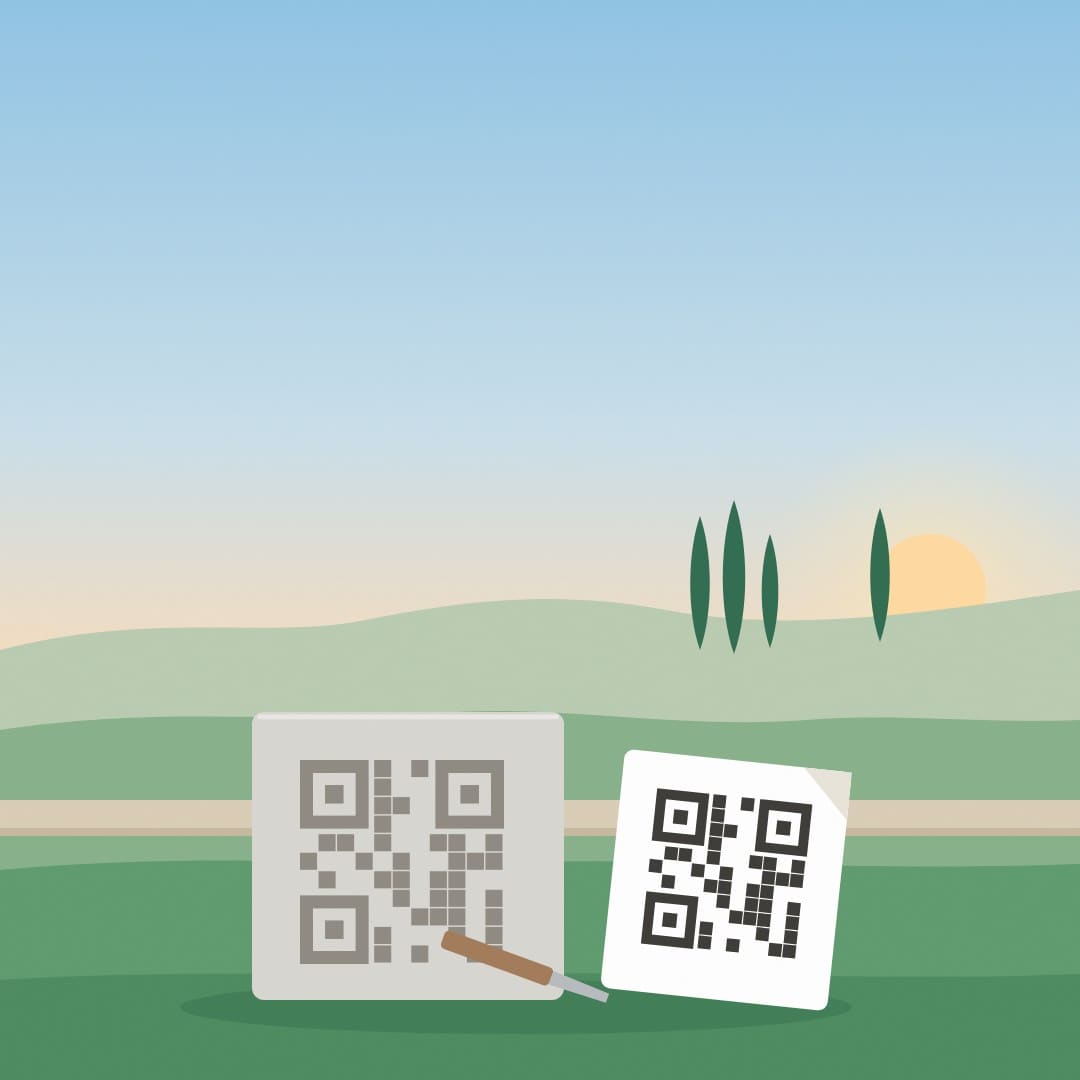
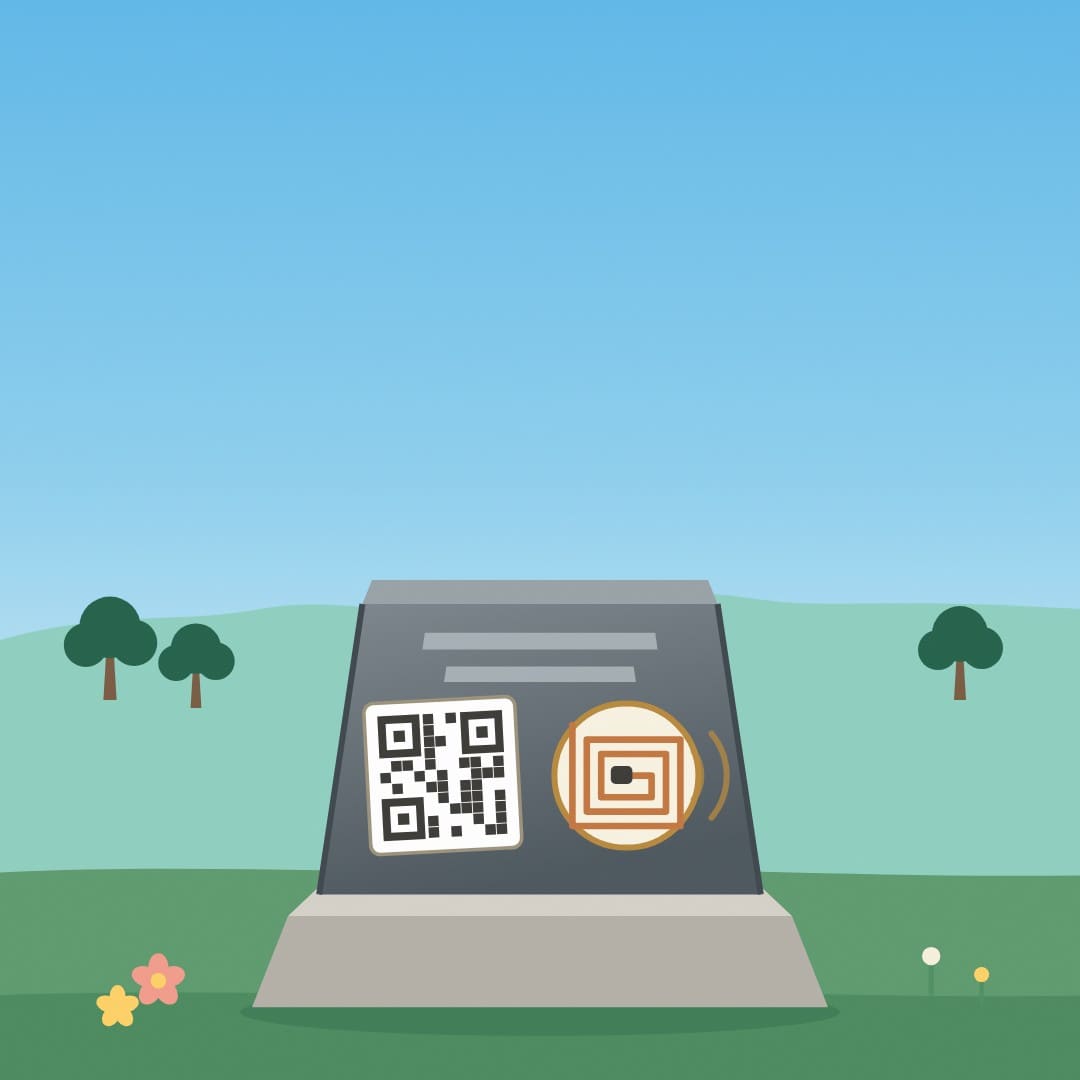
On a headstone, the QR code is the universal option: any phone camera reads it, with no app and no settings. An NFC chip opens the same page without the camera, but it needs a compatible phone, a touch, and there is only ever one of it.
So the two are not rivals. The real question is what the second adds to the first.
A pattern versus a component
A QR code is a printed pattern: it does not contain the page, it contains the page's address in black and white, and the phone camera decodes it. Anything that reduces the contrast reduces the chance of a read.
The chip is a component with no battery; the customs declaration calls it a "passive NFC tag (no battery)". It draws its power from the radio field of the phone held near it, just long enough to pass on the address. There is nothing to aim at: a chip under a film of dust does not notice.
What you need to read them
For the QR code: a phone with a camera. Nothing to install, no minimum model.
For the chip, there are more conditions. Apple states that background reading, with no app, has been available since the iPhone XS, and describes three steps: the screen is on, a notification appears, the user taps it, after unlocking if the phone was locked (Core NFC documentation, read on September 28, 2026). On Android, the phone only looks for chips when the screen is unlocked and NFC is turned on.
Above all, Android has changed. Its documentation says so: since Android 16, a chip carrying a web link no longer triggers the same mechanism, and since Android 17 you have to tap an "open link" notification for anything to open (developer.android.com, "NFC basics", section How NFC tags are dispatched to applications, read on September 28, 2026).
The line you read everywhere, with contactless, the page just opens, is true neither on iPhone nor on recent Android phones: both ask for the same tap, and the gap in convenience with a QR code is narrower than the market claims.
1.5 meters on the data sheet, under an inch in your hand
NXP gives this type of chip a read range of "up to 1.5 m, depending on antenna geometry" (about 5 feet; SL2S2602 data sheet, revision 4.2, read on September 28, 2026), and specifies gate width: that is the width of a library security gate, not a phone. The figure that applies to you comes from the NFC Forum: a typical range of up to 2 cm (under an inch), and 5 mm for certified compliance (read on September 28, 2026). Nobody reads a grave from the path: you lay the phone on it.
Lifespan: two kinds of wear with nothing in common
For the printed code, the answer is a matter of years and depends mostly on where it sits and how it was fixed. As of September 28, 2026, we found no solid manufacturer source on how QR code ink holds up outdoors, or on the effect of frost. The ten years sometimes quoted come from a vinyl film that is unprinted, unprotected and outside any guarantee (3M, IJ180/180C product bulletin, October 2015): that is not a printed code.
For the chip, a figure exists. The reference used, an NXP ICODE SLIX2 (SL2S2602), states 50 years of data retention, at an ambient temperature of 55 °C (131 °F) or below (data sheet revision 4.2, December 1, 2021, read on September 28, 2026). Two details make all the difference: the temperature condition is part of the figure, and it is the retention of the memory, not the life of an object stuck to granite. Neither the antenna, nor the casing, nor the adhesive is covered by those 50 years.
The same document publishes no operating temperature range: only absolute maximum ratings, with storage from −55 to +125 °C (−67 to 257 °F), and a note that operation at those values is not guaranteed. Writing that the chip "works from −40 to +85 °C" turns destruction limits into a promise. A temperate winter does not threaten the silicon; about the adhesive, the manufacturer says nothing.
What happens when one of them fails
A QR code has error correction built in. The ISO/IEC 18004:2024 standard (§ 5.1, item f) defines four levels, L, M, Q and H, that can restore 7, 15, 25 or 30% of the symbol's codewords, depending on the level chosen when the code is generated (public preview of the standard, read on September 28, 2026). These are codewords, not a share of the surface you could cover up. The usual level is M, 15%: "Typically, Level M (15%) is most frequently selected", writes Denso Wave, which invented the format ("Error Correction Feature" page on qrcode.com, read on September 28, 2026). A QR code degrades in stages and gives plenty of warning before it stops working. The chip is binary: it works, or it does not.
Simpler still, and you can check it when you open the parcel: an order contains three stickers carrying the same code, and a single chip. The QR code has two spares; the chip has none.
Hence the conclusion, the reverse of the usual pitch: the chip is the convenience, not the backup.
If you have it engraved, the chip does not follow
The chip belongs to the sticker, not to the stone: an engraving leaves you the code and never the contactless option, one more factor in that choice. The spot itself is prepared the same way for both.
Which plan includes the chip
It is not sold separately: it is included in the Heritage and Eternite plans, not in the entry Souvenir plan. It is the only physical item that sets the three plans apart; the rest, storage and length of the guarantee, comes down to software and commitment.
As of September 28, 2026, the cheapest way to get the contactless option is therefore €39, against €19 for Souvenir, in one payment. Prices are in euros wherever you buy from. How pricing works across the market is covered in what a memorial QR code costs.
Two last details: we do not make an NFC plaque, the chip is fixed to the sticker; and each chip is programmed by hand with the memorial's address before shipping, a step that counts toward the delivery time.
Not sure yet what the object itself is for? The main guide to memorial QR codes.